 By
By
Airway management devices, including endotracheal tubes, are used to secure, maintain and protect airways; and provide a route to deliver and remove anaesthetic gases and volatile agents. Discover more about endotracheal tubes, cuffs and cuff inflation techniques.
Although tracheostomies for airway management have been reported since 3600BC, it was only in the 19th century that orotracheal intubation was seriously considered: In 1858, Eugene Bouchut used a metal tube to bypass a laryngeal obstruction, and in 1880 Scottish surgeon William Macewan utilised orotracheal intubation to administer chloroform anaesthesia. In the 1920s Sir Ivan Magill developed the familiar red rubber endotracheal tube (ETT), the forerunner of the PVC ETT that has become the standard tube in use today (Haas et al., 2014).
Although other airway management equipment such as supraglottic airway devices, laryngeal masks and tracheostomy tubes are available, this article will focus on the endotracheal tube and its associated cuff.
Why intubate?
During general anaesthesia, endotracheal intubation is used to maintain and protect the airway of the unconscious patient. The ETT offers a route for the delivery of oxygen, other gases, volatile anaesthetic agents and some drugs, and allows the removal of carbon dioxide. When used appropriately, the ETT helps to protect the airway and lungs from aspiration of e.g., gastric contents, blood, other fluids and debris, and provides a route for mechanical or manual ventilation. ETTs can also direct exhaled anaesthetic gases to suitable scavenging systems helping to reduce local and global environmental contamination (Reuss-Lamkey, 2018).
Endotracheal tube design
ETTs are manufactured from a variety of materials, most commonly red rubber, polyvinyl chloride (PVC) and silicone. Tubes are identified according to internal diameter, with the external diameter varying dependent on the material used and wall thickness, something that should be considered when selecting the appropriate size of ETT. They come with a bevel; may or may not have cuffs; they can be armoured; may have inbuilt laser protection; have radio-opaque and length markers; and may have a Murphy eye (Figs 1 & 2).
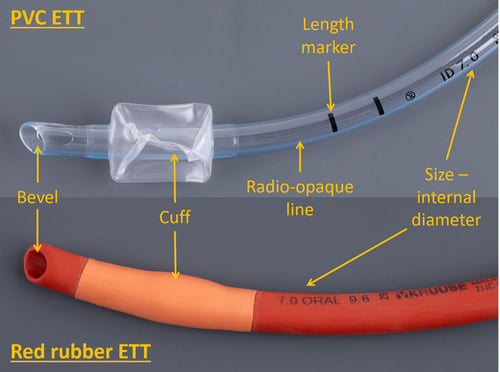
Figure 1: PVC ETT & Red rubber ETT
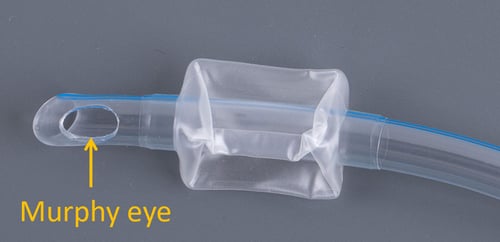
Figure 2: Murphy eye
The most commonly used ETT material is PVC. It is inexpensive and less irritant to soft tissues than red rubber, and less prone to kinking. Unlike opaque red rubber tubes, the clear walls of PVC ETT allow easy visualisation of blockages and foreign materials in the lumen.
Armoured ETT used e.g. during head and neck surgery when the tube may be sharply bent, have a wire coil embedded in the tube wall. These ETT are designed to give strength and resistance to kinking and compression whilst maintaining flexibility.
Oxygen is a flammable gas and the high concentrations delivered during anaesthesia pose a combustion hazard. Laser resistant tubes have an external laser-resistant foil wrap to minimise the risk of airway fires.
The “Magill Curve”, approximating the natural anatomical arc of the airway, is incorporated in most ETTs, allowing the tube to naturally follow the course of the airway during insertion.
The bevel (Fig 1) at the patient end of the tube permits better visualisation of tissues e.g. the epiglottis, ahead of the advancing tip during insertion. However, the angle of the bevel is designed for right-handed insertion, as are most laryngoscope blades, making intubation slightly more challenging for left-handed operators.
The Murphy eye (Fig 2) is present just behind the bevel in some ETT (Murphy endotracheal tubes). This additional opening provides a secondary route for gas flow should the bevel become blocked, or occluded against the wall of the trachea, although secretions and other materials can also block the Murphy eye. ETTs without a Murphy eye are known as Magill tubes.
Endotracheal cuff design and cuff-related pathology
Endotracheal tubes are available with and without cuffs. The aim of the cuff is to create a gas and fluid-tight seal between the tracheal wall and ETT to minimise the risk of aspiration and to allow intermittent positive pressure ventilation (IPPV) (Grubb et al., 2020).
Cuffs come in two main designs: low volume high pressure (LVHP); and high volume low pressure (HVLP).
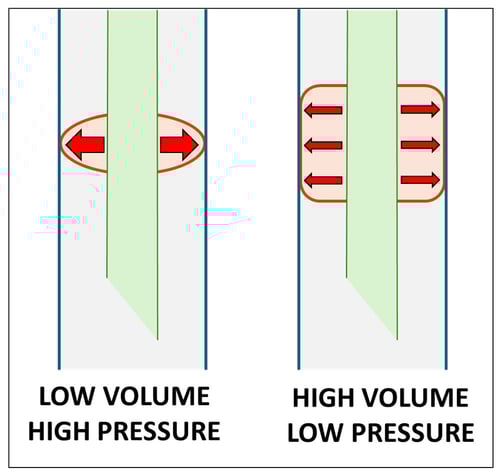
Figure 3: LVHP and HVLP cuff contact with tracheal mucosa
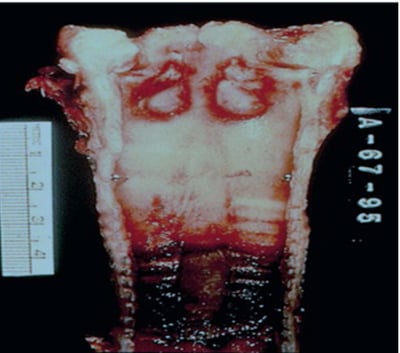
Figure 4: Tracheal mucosal ulceration & necrosis
Courtesy of Mohammed.abulzahra@mustaqbal-college.edu.iq
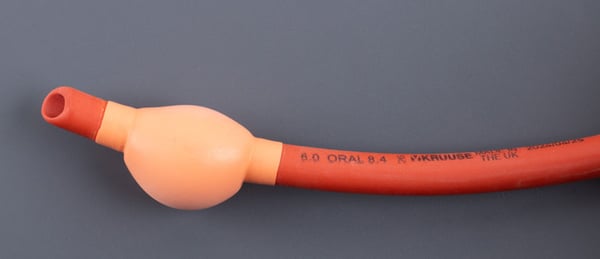
Figure 5: Uneven cuff filling in a new red rubber ETT
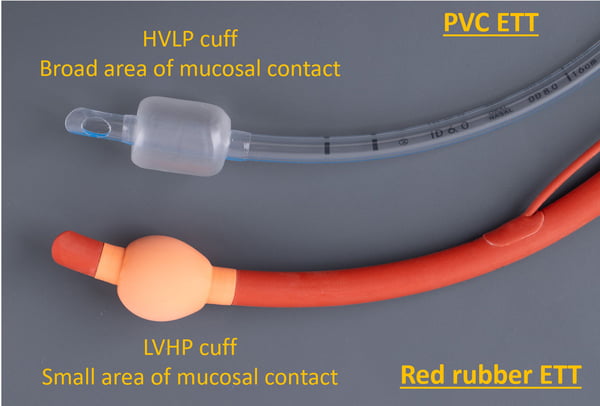
Figure 6: Area of mucosal contact. LVHP red rubber tube cuff versus HVLP PVC tube cuff
LVHP cuffs are mainly associated with red rubber tubes. Although they create a good seal, the contact area with the tracheal wall is small (Fig 3) and there is significant risk of tracheal injury, with resultant ulceration and/or necrosis via ischaemic occlusion of the tracheal vasculature (Fig 4) (Loeser et al.,1978; Riley et al.,1999). LVHP cuffs also have a tendency to inflate unevenly (Fig 5) and they may even herniate (Bergadano et al. 2004), resulting in inadequate seals and uneven pressure distribution, significantly contributing to pressure necrosis of the adjacent tissues.
HVLP cuffs, as found on PVC tubes, conform to the shape of the trachea when inflated to the correct pressure (see later), and contact between cuff and the tracheal mucosa is spread over a wider area than with the LVHP cuffs (Fig 3 & Fig 6). The broader cuff-mucosal contact area with HVLP cuffs minimises compression of the tracheal vasculature and reduces, but does not eliminate, the possibility of cuff-related injury.
In human medicine the red rubber tubes have been almost entirely superseded by less irritant, single-use PVC ETT with HVLP cuffs.
The characteristics of PVC versus red rubber ETTs are summarised on Table 1.
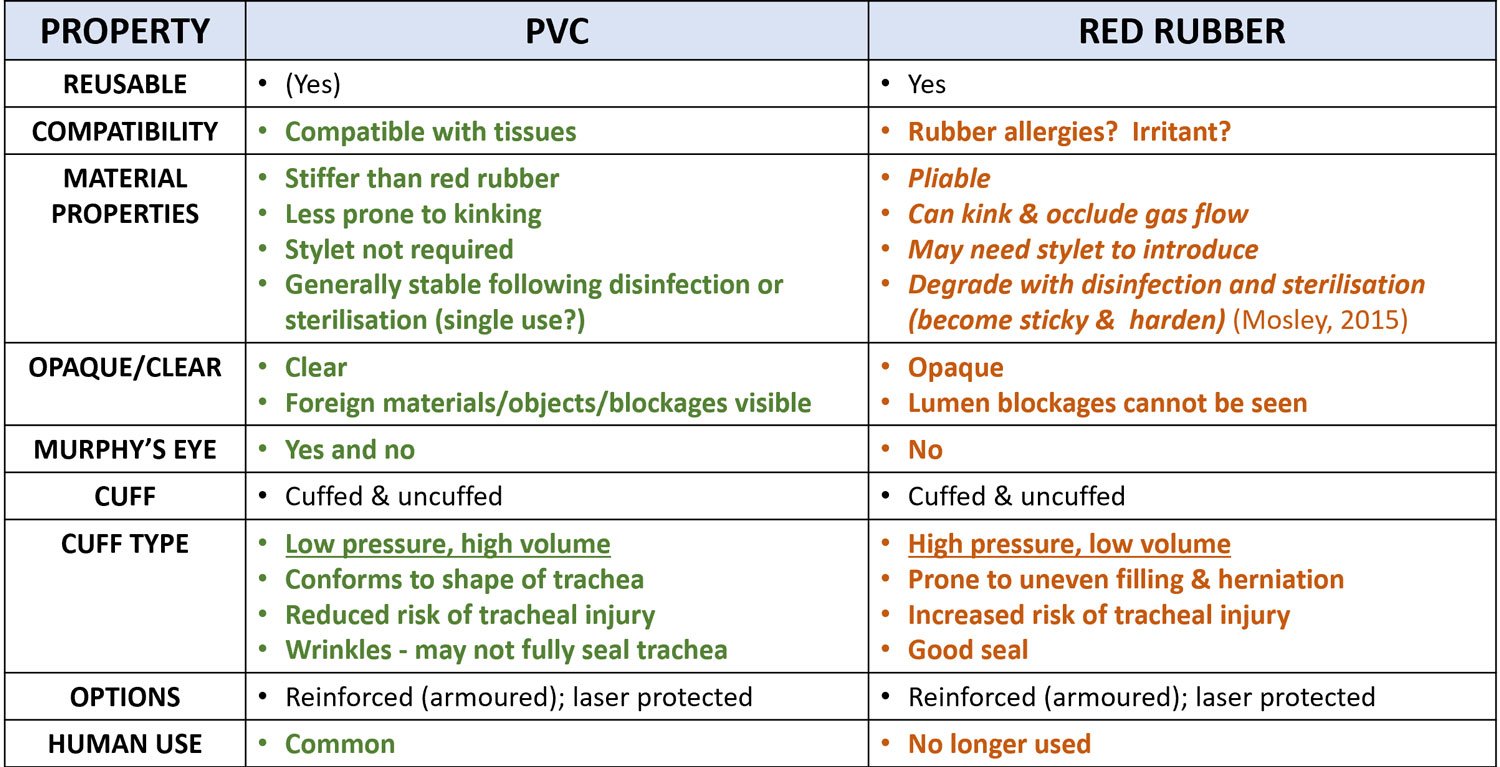
Table 1: Comparison of PVC and red rubber endotracheal tubes
Endotracheal tube cuff inflation pressure
The ideal cuff inflation pressure should be sufficient to create a seal between the trachea and outer wall of the cuff, but not so high that tracheal mucosal blood flow is impeded. If the cuff is inflated to the point of occlusion of the capillaries in the tracheal wall, circumferential ischaemic necrosis and subsequent fibrosis can result in progressive tracheal stenosis. In addition, overinflation of ETT cuffs can cause mucosal tears and even tracheal ruptures, especially in cats (Alderson et al., 2006; Holt, 2015).
The contribution of hypotension must also be considered: In dogs with a mean arterial pressure of 50mmHg or less, tracheal mucosal perfusion is reduced by 50 percent. Therefore, the combination of an overinflated cuff in a hypotensive patient significantly increases the risk of mucosal ischaemic injury (Alderson et al., 2006).
Whilst there is a lack of evidence recommending cuff inflation pressures in veterinary patients (Hughes, 2016), tracheal mucosal ischaemia has been reported at cuff pressures exceeding 30cmH20 (Seegobin & van Hasselt 1984), and inadequate seals at less than 20cmH2O (Mu et al., 2024). Therefore, based on the human literature and experimental studies (Mu et al., 2024), PVC HVLP cuff pressures of 20-30cmH2O are the current guidance for veterinary patients (Hung et al., 2020).
A light coating of sterile lubricant jelly may not only improve ease of intubation but may also improves the ability of the cuff to seal the airway (Grubb et al., 2020).
Cuff inflation techniques
Several non-quantifiable techniques for ETT cuff inflation have been advocated in the past, but non provide a sufficient level of accuracy to ensure patient safety.
In a study of human anaesthesia, assessing cuff pressure by palpating the pilot bulb resulted in alarming cuff pressures of 10 to120cmH2O, with 65% of patients experiencing cuff pressures exceeding 30cmH2O (Gilland et al., 2015). This data was corroborated by Mu et al. (2024) who reported “finger touch” cuff pressures ranging from 26 to 88cmH20, with 73% of patients experiencing pressures of more than 30cmH2O. In the same study, only 20% of human medicine anaesthetists checked or monitored cuff pressure intraoperatively.
The minimal occlusion volume (MOV) technique has been advocated for veterinary ETT cuff inflation by some authors in the past (Crimlisk et al., 1996; Guyton et al., 1997). With this method, the adjustable pressure limiting (APL) or pop-off valve is closed and the reservoir bag squeezed to deliver a peak airway pressure of 20cmH2O. At the same time, air leakage around the ETT is assessed by listening. If gas is heard escaping, the ETT cuff is gradually inflated with the smallest volume of air necessary to prevent gas leakage around the tube. However, in a study in dogs, the MOV method resulted in 76-80% of cuffs being overinflated (above 30cmH2O), and only 3.3% were within the recommended range of 20-30cmH2O (Hung, 2019). White et al., (2020) also reported poor performance with the “finger touch” and MOV techniques in cats.
The studies reporting the excessive cuff inflation using the “finger touch” and MOV techniques demonstrate the critical need to accurately assess cuff pressure to ensure appropriate inflation (Bellows, 2022). The two most commonly used devices used in veterinary medicine are the Tru-Cuff™ and the AG Cuffill. In a canine study examining cuff inflation with these devices, 50% of cuffs were inflated appropriately with the Tru-Cuff™ (to the target range of 20-30cmH2O). For the AG Cuffill, 87% of cuffs were correctly inflated (Hung, 2019). Similar results for the AG Cuffill have been reported in cats, with no cases of overinflation above 30cmH2O (White et al., 2020).
AG Cuffill
The AG Cuffill (Fig 7) combines a syringe with an electronic manometer and, as it has a wide pressure range, can be used with HVLP PVC ETTs, tracheostomy tubes, laryngeal masks, and supraglottic airway devices.
To inflate a cuff:
- Press the yellow power button – it will blink twice and indicate the number of uses remaining
- Ensure the display reads 00
- Draw air into the syringe (this can also be done before turning the device on)
- Connect to the cuff inflation tube
- Inflate the cuff to the appropriate pressure (20-30cmH2O for HVLP cuffs)
- Repeat steps 3-5 for large volume cuffs
*There may be a fall in pressure of 1-2cmH2O when disconnecting the AG Cuffill.
To check cuff pressure
a) Repeat steps 1 & 2
b) Fully depress the plunger
c) Connect to the cuff inflation tube
d) Read the pressure
e) Inflate or deflate the cuff to the required pressure as per steps 3-5 above
Intraoperative alterations to cuff pressure and consequences
Overinflation of the ETT cuff can be a cause of tracheal tears in cats (Holt, 2015), as can changing patient position (Mitchell et al., 2000; Grubb et al., 2020). Indeed, in cats undergoing dental procedures, mucosal tears and other injuries are common (Holt, 2015). This was highlighted by Alderson et al., (2006) who reported areas of tracheal necrosis were larger than the surface area of the ETT cuff, suggesting movement of the cuff and the development of secondary areas of ischaemia. Tracheal ruptures as a consequence of excessive cuff-pressure are not unknown (Mitchell et al., 2000).
To avoid rotation of the ETT and cuff in the trachea, the ETT should be disconnected from the breathing system before changing patient position (Grubb et al., 2020)
Nitrous oxide
Although not commonly utilised in modern veterinary practice, nitrous oxide can significantly affect ETT cuff pressures. Nitrous oxide is a partition gas and is known to diffuse into air filled ETT cuffs (Alderson et al., 2006) causing an increase in pressure above 30cmH2O, with consequential tracheal ischaemia, injury and necrosis (Stanley et al., 1974).
If nitrous oxide is being administered to patients with cuffed ETT, either pressure regulating cuff valves, such as the Lanz valve, should be employed, or cuff pressures regularly monitored and adjusted (Abud et al., 2005).
Monitoring cuff pressures
Based on the understanding the effects of excessive (or inadequate) cuff inflation, the effects of patient positioning, and the consequences of nitrous oxide diffusion into ETT cuffs, it is recommended that continuous, or at least regular, cuff pressure monitoring should be employed during anaesthesia. If cuff pressures stray outside the recommended 20-30cmH2O, they should be adjusted accordingly (Mu et al., 2024).
Other causes of tracheal injury
Although incorrectly inflated cuffs, and inadequate cuff pressure monitoring & management are major contributing factors for tracheal injury, other causes include improper ETT selection (diameter and/or length); injury from endotracheal stylets; failure to deflate cuffs during extubation (Bhandal & Kuzma, 2008; Hardie et al., 1999);
aggressive intubation, especially in cats, brachycephalics, and patients with pre-existing respiratory disease; an inadequate plane of anaesthesia; poor visualisation of the airway; and failure to use laryngeal local anaesthesia in cats, rabbits and critical patients.
Conclusion
Endotracheal intubation remains the most commonly used technique for airway management, and correctly inflated cuffs (to 20-30cmH2O for HVLP cuffs) provide protection of the airway and create an appropriate seal for the provision of IPPV. However, cuff overinflation is commonly observed, especially with traditional cuff inflation techniques, and can result in serious, potentially fatal, consequences.
Recent studies have established the use of cuff inflation devices that incorporate a manometer ensure more precise inflation pressures. The greatest accuracy for inflation within the target range of 20-30cmH2O in both cats and dogs was observed with the AG Cuffill (87% of cuffs correctly inflated). Additionally, regular monitoring and maintenance of cuff pressures within the accepted range, especially if patients are repositioned and/or if nitrous oxide is used, can help minimise tracheal injury.